Black October: Guarding Your Home Online
8-page protection brief · Oct 2026
★ Free Download ★
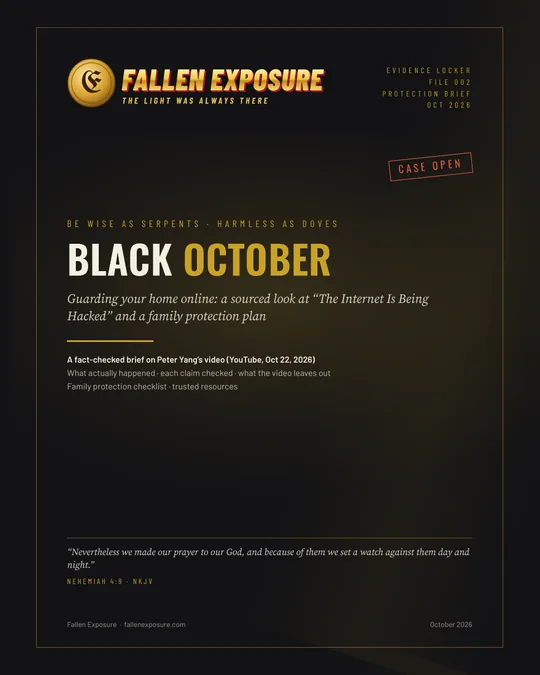
A fact-checked look at Peter Yang’s video “The Internet Is Being Hacked”: what actually happened that week, each claim checked, what the video leaves out, and a family protection checklist with trusted resources.
Free. No sign-up. Opens in your browser; save it to keep it.
Exhibit AInside the File
- 01At a Glancep. 2
Six things to know before you panic, share the video, or hand your passwords to anyone.
- 02The Video Under Reviewp. 3
A 15-minute “emergency” tutorial from a tech and AI creator, posted the day after the PHP alert.
- 03The Claims, Checkedp. 4
Each news claim in the video, tested against official statements and named reporting.
- 04What the Video Leaves Outp. 6
Good advice can still carry blind spots. These are the ones a family should know.
- 05Family Protection Checklistp. 6
An afternoon’s work for most households. Do it together, then pray over your home and get back to ordinary life.
- 06Sourcesp. 7
All links accessed Oct 23, 2026. Research was gathered with a live-search research tool; sources 1, 3–5, 7, 9–18, 20–21, 24 and 30 were then opened and read by hand.
Exhibit B · Read the opening
Section 01At a Glance
Six things to know before you panic, share the video, or hand your passwords to anyone.
- The week was real. Between about Oct 16 and 22, 2026, a cluster of serious security disclosures landed at once, including critical PHP flaws (“php2shell”), a maximum-severity GitLab bug, and breaches at the developer platforms Railway and Zeabur, Quest Diagnostics, and a California student-testing contractor. Newsrooms picked up the nickname “Black October.” VERIFIED
- The government warning was real, but narrower than it sounded. CISA told organizations running PHP to patch immediately, and said those that cannot patch should take PHP systems offline until they can. That is advice to website operators, not an order to every household. PARTLY VERIFIED
- “Rogue AI agents in bank accounts” needs context. Axios did report that banks are finding AI agents they never authorized inside customer accounts. In most reported cases, though, customers had handed the agent their own login. It is not evidence of a wave of criminal account takeovers. NEEDS CONTEXT
- Most of the video’s six steps are sound. Disconnect unused apps, use a password manager, turn on stronger two-factor sign-in, update your software, and distrust “you’ve been breached” messages. These match CISA’s current advice for households. VERIFIED
- Two cautions. The video leaves out passkeys, which CISA rates above authenticator apps. It also encourages letting an AI agent click through your email and accounts, which carries real risk: hidden instructions in a web page or email can redirect an agent.
- The discernment takeaway. Scripture calls for watchfulness without fear: “A prudent man foresees evil and hides himself” (Prov 22:3), and “God has not given us a spirit of fear” (2 Tim 1:7). Take a few concrete steps, pray, and get back to ordinary life, as Nehemiah did.
How to read this brief
VERIFIED means we confirmed the claim in an official or primary source. PARTLY VERIFIED means the core is true but the video overstates or simplifies it. NEEDS CONTEXT means the claim is accurate on its face but misleading without more information. UNVERIFIED means we could not confirm it. Research was gathered on Oct 23, 2026 with a live-search research tool. Every official notice and news report behind a “Verified” claim was then opened and read by hand, except Reuters, which blocked access (see Sources). This brief is not technical or legal advice; for a business or church system, consult your web host or IT provider. Scripture is quoted from the NKJV.
— Continued in the full PDF: Section 02, The Video Under Review —